Before an active ingredient enters the laboratory, could scientists predict how it might change skin cells? When several ingredients are used together, could they identify which combinations merit testing? And if a desired cellular state is known, could they work backward to identify promising interventions?
These questions address a longstanding challenge in beauty research: with countless ingredients, combinations and experimental conditions, how can scientists make better decisions about what to investigate next?
On November 5, during Guangzhou International Beauty Week, Shanghai mathAI Technology Co., Ltd. (mathAI), Guangzhou Quality Inspection and Research Institute, Unilever and the School of Mathematical Sciences at Shanghai Jiao Tong University jointly unveiled DermCosmos and launched joint research into AI-driven cosmetic safety and efficacy evaluation.
The collaboration traces back to May 2026, when the Guangdong Medical Products Administration proposed exploring the use of artificial intelligence in cosmetic efficacy validation, encouraging cooperation among regulatory-related institutions, industry and academia. Against this backdrop, mathAI, Guangzhou Quality Inspection and Research Institute, Unilever and the School of Mathematical Sciences at Shanghai Jiao Tong University are combining their complementary strengths to connect AI prediction with cosmetic safety and efficacy evaluation research.

Photo: Launch of DermCosmos, the skin-specific virtual cell world model.
The partners describe DermCosmos as the world’s first skin-specific virtual cell world model. Behind this designation is a research approach with potentially far-reaching implications for beauty: moving from observing skin cells to predicting their responses to interventions, and then returning those predictions to the laboratory for validation.
The significance of the launch lies in its ambition to reshape the relationship between ingredient research and experimental decision-making.
01 Why Virtual Skin?
Efficacy-driven skincare ultimately needs to answer concrete questions: Which biological processes does an ingredient affect? Under what conditions might it work? And how do observed changes relate to safety and efficacy research?
Skin consists of multiple cell types and complex tissue structures. Age, ultraviolet exposure, environmental stress and inflammation can alter cellular states and responses. The same ingredient may not produce the same effect in different biological contexts.
Advances in single-cell and spatial omics allow researchers to describe these differences in greater detail. The resulting data improve our understanding of skin while raising a new question: can existing observations help predict the outcomes of experiments not yet performed?
According to the research team, DermCosmos learns from large-scale human skin single-cell transcriptomic data, linking cell states, perturbation conditions and biological responses. Given an initial cell state and an intervention, it predicts how the cell may change, and explores the direction of change under continued or combined interventions.
Here, a “world model” refers to learning states and the rules governing their changes. Its value must ultimately be demonstrated through testable questions, such as which pathways candidate ingredients may affect, how combinations may alter responses, and which experiments deserve priority.
This could enable beauty R&D to introduce more computational prediction before laboratory testing and allocate experimental resources to better-defined hypotheses.
02 The Scientific Foundations Behind the Launch
DermCosmos builds on computational systems biology, dynamic process modeling and perturbation-response prediction.
The project is led by Professor Luonan Chen, Chief Scientist of mathAI. According to Shanghai Jiao Tong University, his long-standing research covers dynamics, networks, causality, early warning of critical transitions and prediction, including the development of dynamic network biomarker (DNB) methods. This work examines how biological systems change and how signals of change can be identified in complex data. [1]
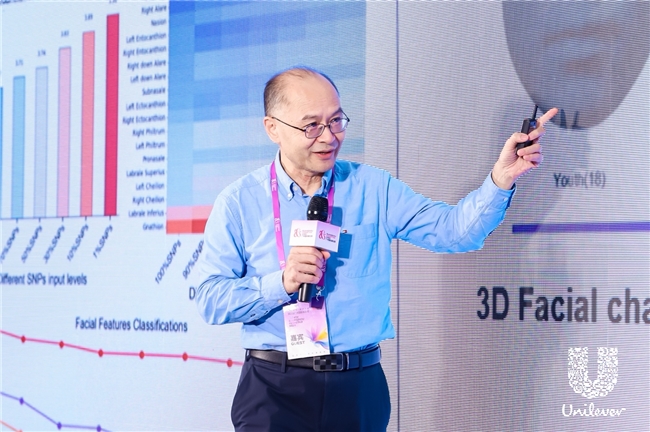
Photo: Professor Luonan Chen presents the research and model benchmarking at the conference.
These approaches are closely related to the challenge of virtual skin: researchers must understand not only the current state of a cell, but also which factors may alter it and how those changes unfold.
In September 2026, Shanghai Jiao Tong University reported that Professor Chen and collaborators published UniCure in Cancer Cell. Combining biological and chemical foundation models, the study learned transcriptomic changes before and after drug perturbations and explored personalized drug prioritization through adaptation to patient-derived samples. It connected molecular-response prediction with the selection of interventions for further validation. [2]
A related advance concerns state transitions. In October, Shanghai Jiao Tong University described CauTrigger, published in Nature Methods by the team and collaborators at the University of Tokyo. Using hierarchical causal decomposition, the work identified potential drivers and their pathways, and used virtual perturbations to predict downstream molecular responses and state changes, generating experimentally testable hypotheses. [3]
Together, these studies demonstrate relevant expertise in perturbation prediction, state transitions and intervention prioritization. They provide methodological foundations, but application to skin still requires dedicated datasets and validation for skin cell types, ingredient interventions and evaluation objectives.
Scientific strength matters because it makes it possible to translate new industry challenges into questions that can be modeled, tested and progressively refined.
03 Benchmarking Against International Models
Beyond the team’s research background, the performance of DermCosmos itself is an important measure of its technical capabilities.
According to benchmark results supplied by the development team, DermCosmos was compared with Geneformer, scGPT, UCE and State. These represent approaches ranging from general single-cell foundation modeling and cross-tissue representation to cell perturbation-response prediction.
Geneformer was first reported in Nature in 2023. Through pretraining on large-scale single-cell transcriptomes, it learns relationships among genes and transfers that knowledge to tasks such as gene function and cell-state analysis. In-silico gene perturbations can also suggest potential regulators. [4]
scGPT, developed by Bo Wang’s team and reported in Nature Methods in 2024, applies generative pretraining to single-cell research. Its representations of genes and cells can be fine-tuned for cell-type annotation, data integration, multi-omics analysis and perturbation prediction. It offers a reference for general-purpose models in skin intervention tasks. [5]
UCE (Universal Cell Embedding), reported in Nature in 2026, combines gene expression and protein sequence information to build unified mathematical representations of cells across datasets, tissues and species. It provides another comparison for transferring general cell representations to skin tasks. [6]
State, developed by Arc Institute and reported in Cell in 2026, focuses more directly on intervention responses. It combines State Embedding, which learns cellular states, with State Transition, which learns intervention effects, to predict gene expression after genetic or chemical perturbations while accounting for differences across cells and experiments. [7]
In the skin-data benchmark supplied by the development team, using the same test set and gene panel, DermCosmos ranked first among the evaluated models on both absolute PCC (0.9828) and ΔPCC (0.5754). Geneformer ranked second on both metrics, with 0.9820 and 0.5639 respectively.
| Model | AbsolutePCC | ΔPCC |
| DermCosmos | 0.9828 | 0.5754 |
| UCE | 0.9627 | 0.4977 |
| Geneformer | 0.9820 | 0.5639 |
| scGPT | 0.9800 | 0.5273 |
| State | 0.6756 | 0.1393 |
The metrics capture different aspects of performance. In general, absolute PCC measures the correlation between predicted and observed gene expression, while ΔPCC focuses on agreement in expression changes relative to a control state. The first reflects overall expression patterns; the second is more specific to perturbation-induced changes.
These findings illustrate the potential of skin-specific modeling. By combining skin biology with intervention conditions, DermCosmos aims to move beyond describing present cell states toward predicting responses, supporting active-ingredient screening, mechanism research and experimental design.
Numerically, DermCosmos exceeded second-ranked Geneformer by 0.0008 in absolute PCC and 0.0115 in ΔPCC. These results establish its first-place ranking on the two metrics in this particular benchmark.
04 Unilever Brings Real-World R&D Conditions
The value of a model in beauty R&D depends on whether it can address real research questions.
Which active ingredients should be prioritized? Which biological endpoints matter? Which predictions warrant follow-up experiments? When results differ from expectations, should researchers revise the hypothesis, collect more data or redefine the model’s applicability? Such decisions require expertise in skin biology, ingredients, formulation science and experimental research.
Under the collaboration, Unilever will contribute expertise in skin and scalp biology, active ingredients and formulation science, alongside wet-lab research and validation capabilities including cell-based and three-dimensional skin models. These capabilities will support model development, iterative validation and application, helping connect computational research to industrial R&D.
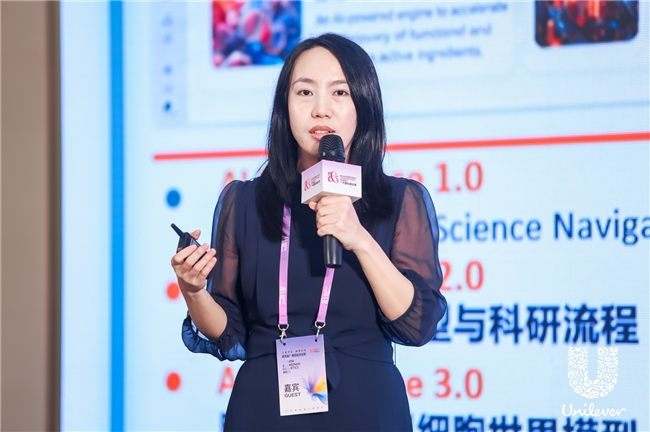
Photo: A Unilever R&D representative shares practices in AI-enabled science and cosmetic innovation.
For example, a model could compare predicted cellular responses to candidate actives before a subset is selected for laboratory testing. For combinations, it could help formulate mechanism-based hypotheses for experimental verification. Experimental results would then help test predictions, define applicability boundaries and improve the model.
Erica Liang, R&D Strategy and Operations Lead at Unilever, said: “By combining skin science, predictive models and experimental validation, we hope to deepen our understanding of how ingredients affect the skin and translate those insights into better products and consumer experiences.”
From an industry perspective, the value of this collaboration is to establish a continuous link between AI and experimental R&D. Model performance should ultimately be judged by experimental outcomes and improved research decisions.
05 Why an Evaluation Institution Is Involved
Guangzhou Quality Inspection and Research Institute adds a crucial dimension to the collaboration: how model predictions can connect to safety and efficacy evaluation.
For researchers, a prediction may suggest a promising direction. For evaluation purposes, further questions arise: Can the result be reproduced? Under what conditions is it applicable? What scientific conclusions can it support?
Under the project arrangements, the Institute will contribute its expertise in testing, evaluation and standards development, helping connect model predictions with evaluation research and build evidence for future methods and standards.
Model outputs may provide research leads, but turning those leads into evaluation evidence requires traceable data sources, appropriate experimental designs, reproducible results and clearly defined applicability. Addressing these questions together can advance model development and evaluation methodology in parallel.
At this stage, the project aims to build credible evidence in support of regulatory science and methodological innovation; it does not claim that the model has received regulatory endorsement.
06 Building Evidence Beyond the Launch
For the beauty industry, DermCosmos raises a longer-term question: as AI begins predicting changes in skin cells, what research capabilities should companies build?
The connections among models, data and experiments will become increasingly important. Scientists must frame questions suitable for modeling; AI teams must understand biological context; and laboratory teams must translate predictions into testable protocols.
This collaboration may also change how past research is used. Historical cell states, intervention conditions and response data could inform future predictions and experimental design, while new experiments would continuously improve understanding of skin.
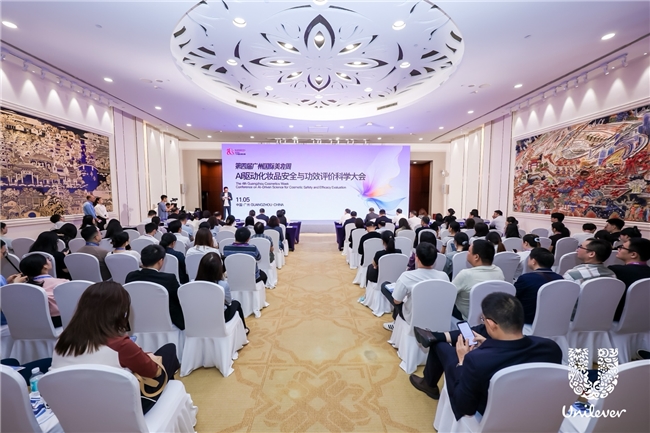
Photo: Conference on AI-driven cosmetic safety and efficacy evaluation at the 4th Guangzhou International Beauty Week.
The four-party collaboration brings together mathematical modeling and AI, skin and formulation science, experimental validation, and testing and evaluation expertise.
The story of DermCosmos therefore extends beyond its debut. Will it remain reliable across skin cell types and interventions? Can it help researchers select better candidates? Can repeated experimental validation produce methods that are reproducible and transferable? The answers will shape the future role of virtual skin models in beauty R&D.
The global launch reveals a new research possibility; the scientific foundations and continued validation behind it will determine its eventual industrial value.